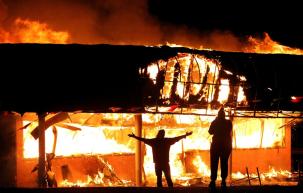
 I remember watching our city burn. I remember seeing fires in every direction, gunshots cracking in the night, sirens blazing 80 mph down Figueroa Blvd through the smoke-filled air. It was May of 1992, and riots would continue for 3 days until the National Guard parked their armored military vehicles in South Central L.A. neighborhoods.
Outside is America
There has been anger in the streets of America for generations. Clearly we have a long way to go in our national discourse to address the racial tension lurking beneath the surface. The Ferguson violence of last night was a long time in the making. Roots of this pain and anger can be found in our history of systematic oppression, racial injustice, police brutality, and cyclical poverty. It doesn’t take a scholar of African-American issues to see we have a problem.
But sometimes it takes a riot.
Martin Luther King Jr. said that “a riot is the language of the unheard.” He condemned such violence, but he understood its context and expression. Eldridge Cleaver, a prominent leader of the Black Panther Party, wrote: “We shall have our manhood. We shall have it or the earth will be leveled by our attempts to gain it.”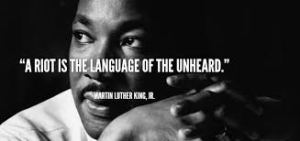
Anger was festering long before Michael Brown was shot and killed. Grievances have lingered and compounded with every stop and frisk, uneven sentencing, and racially profiled traffic stop… not to mention daily dealing with ignorance and prejudiced behavior in grocery stores, workplaces, and public places. If you have no idea of what I’m describing, please go watch the movie Crash.
Making Progress
Have we made any progress since 1992 or the race riots of the late 1960’s? I certainly hope so, and I believe we have. Laws have been changed, voter rights protected, greater education and economic outreach, etc. However, we are still deep in our American experiment to form a “More Perfect Union”, and the whole concept of progress is certainly subjective by nature. 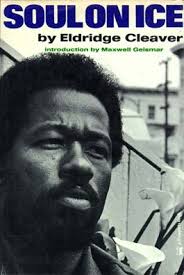
Referring to several hundreds years of racial oppression, Malcolm X noted that, “You don’t stick a knife in a man’s back nine inches and then pull it out six inches and say you’re making progress.” Other people, like Morgan Freeman, have asserted that racism only exists because we keep talking about it. Was Ferguson’s violence simply a reaction to our talking about racially-fueled injustice for the last several months? Maybe, but there was probably a little more to it than that. Whether we give words to it or not, the knife wound is still very real in many of our communities.
Due Process
Michael Brown’s family (and many in the Ferguson community) wanted a full murder trial for Officer Wilson, but the Grand Jury decided there was not enough evidence to indict. There was little transparency in this whole process, poor communication of the facts, and the Ferguson community was left to speculate and expect the worst. And every piece of evidence “leaked” to the media was deemed to be some sort of police propaganda, favoring a non-indictment decision. Was this really considered “Due Process”?
Is there anything that should have been done differently that could have avoided the street violence? Should Officer Wilson have been offered up as a scapegoat (if there was not enough evidence) to alleviate the mob’s growing malcontent? Should we re-examine our whole system of justice in light of this case? 
It seems as if the Grand Jury did their duty in thoroughly examining all the evidence, but the decision still ended in precipitating riots and looting in the community. “So…”, asks White America, “What’s the deal with looting and burning down your own city? Do you disagree with the decision? Are you just mad as hell? Do you just want to take advantage of a chance to break something and steal some auto parts from O’Reilly’s?”
A Complex Response
It is an horrific tragedy that Michael Brown is dead, that Officer Wilson is probably on a hit list, that dozens of local merchants are out of business, that poverty continues to oppress a community. There is no excuse for this looting and violence. There is also no excuse for hundreds of years of racial hatred and oppression.
As the narrative of these events shift from examining the Brown shooting case to the racial tensions in America, we will need men and women of large character who can face the ugliness of our history and do the right thing. We need leaders who will not merely dismiss this violence as shallow thuggery, nor give excuse for its existence. There is no rational sense for looting… and that is why it cannot be ignored.
A Lesson from Los Angeles
There are two things I vividly remember during the L.A. Riots:
1) College students participated in the looting. These students were not racially motivated protesters expressing rage over the Rodney King Verdict. They were opportunists who saw hundreds of others looting stores in the neighborhood. What fun! Let’s join the action and get some free stuff. This had nothing to do with racial tension, only ugly greed. I’m sure that there are quite a few people tonight with new windshield wipers and car fresheners from O’Reilly’s who are convincing themselves that they stole in the name of racial injustice.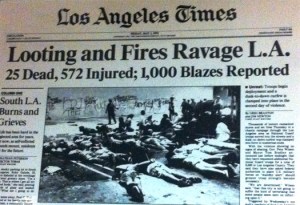
2) When the four white officers were acquitted, the city erupted in riots that night. When the dust settled days later, the primary victims of the riots were Koreans and African-American residents. Yes, poor Reginald Denny was pulled from his truck and beaten to a pulp by an angry mob, but the looting and racial violence was particularly focused on Koreans.
I bring up these two observations because when riots begin, all “social justice” messages are lost. Thugs and vandals rule the streets, revenge and destruction take precedent, and the streets become a mosh-pit of idiocy. There is no rational thought such as, “I am upset about the Michael Brown case, therefore I will go steal some auto parts.” It is chaos and a devolution of civilization, an opportunity for rage to be let loose on anything in the way.
Let our analyses of these riots and their underlying causes never give an inch to condoning such violence. Dr. King knew how to lead us through such formidable waters. We need to continue his work now more than ever.

 schujahn [ ˈshü · jän ]
Amazing commentary. Wise direction.