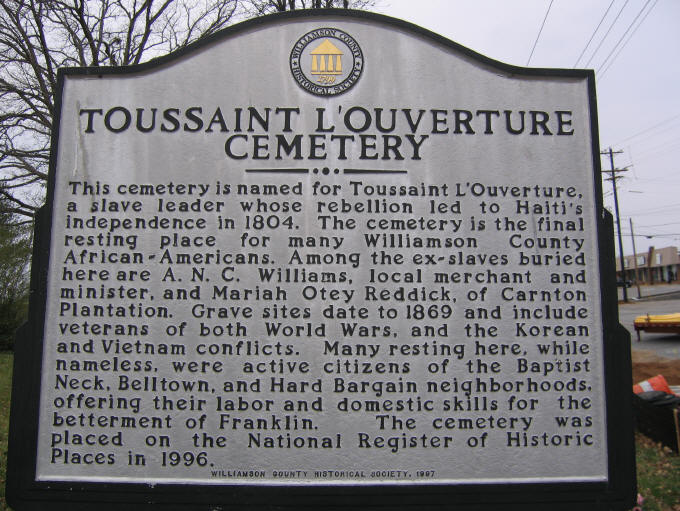
 Just down the road from my house lies an old cemetery, many of whose “residents” were once slaves. It is a reminder of my small town’s heritage where segregation followed a child throughout his life and into death.
A man was buried in this cemetery 80 years ago this month. He was born into slavery, sold to another family at the age of six, and then taken to my hometown of Franklin, TN. His name was A.N.C. Williams.
Upon emancipation in 1863, he stayed in Franklin and became the first African-American to own a business on Main Street. He was 19 years old at the time and eventually became a community leader, part-time pastor, successful merchant, and well respected by citizens of any hue. But history would have its moment.
The Civil War came and raged through town in 1964. His store was destroyed and rebuilt, and ethnic tensions ran deep during Reconstruction. Even with a military “peace-keeping” presence, a small spark was more than sufficient to ignite this proud town into violence.
The spark came when our young businessman was 23…
Now, reading through the accounts of what happened the evening of July 6, 1867 on a website or in book is vicarious in its own respect; but sitting in the town square upon the courthouse steps where bullets flew and blood spilled is somewhat surreal. Imagining the racially mixed column of white and black men marching down Main Street, wielding drums and banners, expressing their freedom to assemble as Franklin’s “Colored League” in support expanded civil rights for “negro citizens”… this is something different altogether.
I never knew this could have ever happened nearly 100 years prior to the Civil Rights Movement of the 1960′s, but yet this group was marching in defiance to centuries of violent injustice and oppression. A.N.C. Williams served as one of this League’s chief leaders, and he was deeply concerned this evening. Rumors were spreading through the ranks of an imminent attack upon their numbers. Still they marched forward into the night through the heart of town.
This “Colored League” was headed directly into an ambush of bitter veterans of a war recently lost; retired Southern soldiers armed with malice, indignation, rifles and rage. They stood with weapons along the store fronts as the League approached, waiting for an opportunity to regain some semblance of Southern pride – even if only for a night – after years of an oppressive “foreign” military occupation.
A.N.C. Williams knew this battle was coming. Tension was building, and they all knew an ambush was just up the street; and yet they marched with a steady cadence and drum beat, rivaling the intense hammering of their own hearts. Some were already prepared for the conflict ahead, holding cold pistols at their sides.
Knowing something must be done, Mr. Williams raced ahead of the League and entered a storefront where a group of white men with rifles had prepared for this night of bloodshed. As a fellow merchant, the men tolerated the presence of this 23 year old former slave. They knew him well and allowed him to speak.
He told the men to be calm, put away their weapons, there would be no need to fight. The League was preparing to disperse and return to their homes after a brief gathering in the town square. But as the words exited his mouth, an argument arose outside in the square between another group of white men and the League. Suddenly a shot rung out, then another shot followed by a barrage of volleys from both sides of the encounter. Bullets riddled the store front, the town square, and many of the backs of young men running in all directions.
A.N.C. Williams fell to the floor to avoid the crossfire; and when the bullets stopped flying, dozens had been injured and one man killed. Williams survived the night uninjured, but what must have been going on in his heart at this moment? Fear? Anger? Sorrow?
I sometimes visit William’s gravesite down the street, located in “Toussaint L’Overture Cemetery” – named after the man who led enslaved Haitians in a struggle for freedom from French colonizers. I think about the history in this place, or any place, really. Who were these that lived? What were they like? What kind of courage was necessary for a 23 year old to run into the den of an ambush and plead for peace amidst certain ethnic violence.
I wish I could have known Mr. Williams and listened to his stories of childhood, of family, of faith, of life. I know every man has his weaknesses, and I’m sure A.N.C. had his own; but I find myself thinking about this young man who lived so long, long ago, in a place not very far from my own doorstep.
Perhaps my search among the dead for unwritten autobiographies is a bit strange, but it is not morbid. It is a exercise in reflection and a celebration of life. It is a gesture of honor for those who gave their lives that we might live in places such as Franklin, TN. My hometown is not perfect, and it has many problems as do many small towns in America, but it is rich in history and has become my home.
My family’s history is now intertwined with that of Mr. Williams. And although I may never have met the man, I will tell the story so that my children, and my children’s children, will know. They will know of this young man, born into slavery, victim of undocumented crimes, who raced into the face of danger with fear and courage and hope, so that one day the descendants of former slaves and slaveholders could move forward to build a new community in true freedom, mutual love and respect.
We still have a ways to go in many areas of this community, but we can always visit A.N.C. Williams whenever we want to remember where we’ve been.

 schujahn [ ˈshü · jän ]